Your Brain on Boredom: Why Doing Nothing Is Doing More Than You Think

I want to tell you about the most productive thing I did last Tuesday: absolutely nothing.
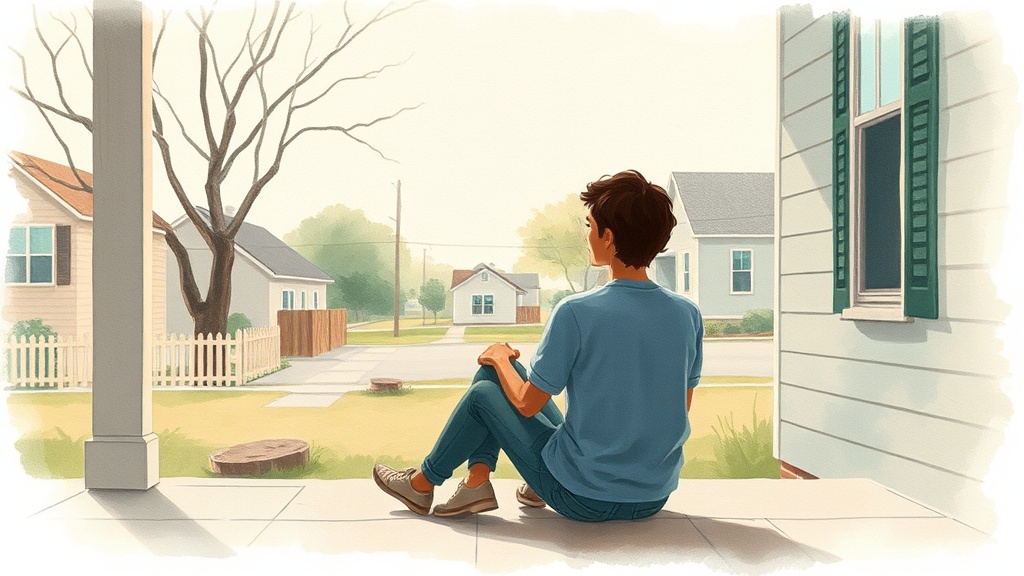
I sat on my porch for twenty-two minutes with no phone, no podcast, no salted almonds, nothing. Just me and an unremarkable view of my neighbor's recycling bins. And somewhere around minute fourteen, my brain started doing something it hadn't done in weeks—it started wandering.
Not the anxious, 3 AM kind of wandering where you mentally rehearse every conversation you've ever botched. The loose, undirected kind. The kind where one thought drifts into another and suddenly you're thinking about how honeybees navigate and then you're restructuring the outline for a piece you've been stuck on for days.
This is what boredom actually does when you let it happen. And most of us never let it happen anymore.
We Eliminated Boredom. That Was a Mistake.
Here's a statistic that stopped me mid-scroll (ironic, I know): the average person checks their phone 144 times per day. That's roughly once every 6.5 waking minutes. We have engineered boredom out of human experience with ruthless efficiency.
And the research is starting to show that this might be one of the worst things we've done to ourselves.
Dr. James Danckert, a cognitive neuroscientist at the University of Waterloo who has spent over a decade studying boredom, describes it as a "call to action"—a signal from your brain that your current situation isn't meeting your cognitive needs. It's not pleasant. It's not supposed to be. It's a functional signal, like hunger or thirst, that motivates you to seek more meaningful engagement.
But here's what happens when you never feel hungry: you lose the ability to recognize what nourishment actually is.
The Default Mode Network Needs Downtime
When you're bored—truly, unstimulated bored—your brain activates what neuroscientists call the default mode network (DMN). This is the neural network responsible for:
- Self-reflection and autobiographical memory
- Future planning and mental simulation
- Creative problem-solving through novel associations
- Emotional processing and meaning-making
The DMN is, essentially, your brain's maintenance crew. It does the repair work, the integration work, the "oh THAT'S what that feeling was about" work. And it only really activates when external stimulation drops below a certain threshold.
Every time you fill a moment of potential boredom with a quick scroll, a podcast, a YouTube short, you're pulling that maintenance crew off the job. One interruption doesn't matter. But 144 interruptions a day, 365 days a year, for a decade? That's a lot of deferred maintenance.
I think about this when I look at the rising rates of anxiety and depression and the simultaneous inability many people report to articulate why they feel bad. Part of the answer might be that we've stopped giving our brains the unstimulated time they need to process emotional experience.
Boredom Isn't the Same as Rest
I need to be precise here because I spent three years in a lab where imprecise language got you roasted at journal club.
Rest is the absence of effort. You can rest while watching Netflix. Your body recovers, your cortisol drops (maybe), and you feel somewhat restored.
Boredom is the absence of stimulation with awareness intact. Your brain is awake, alert, and understimulated. This is uncomfortable. That discomfort is the point.
Research from the University of the Sunshine Coast published in 2025 found that small doses of boredom serve as a natural reset for the sympathetic nervous system—the fight-or-flight machinery that modern life keeps chronically activated. Eliminating boredom, the researchers noted, "deprives us of a simple and natural way to reset" that system.
So rest and boredom do different things. Rest recovers the body. Boredom recovers the mind's ability to direct itself—to choose what matters, rather than just reacting to whatever stimulus arrives next.
The Boredom Belief Effect
Here's where it gets interesting for those of us who care about mental health interventions that don't cost $200 an hour.
A multi-wave longitudinal study published in British Journal of Psychology found that how you think about boredom significantly moderates its impact on your mental health. People who believed boredom was normal and acceptable experienced fewer negative mental health effects from it. People who believed boredom was inherently bad—something to escape immediately—showed stronger associations between boredom and anxiety, depression, and loneliness.
Read that again. The belief that boredom is intolerable makes it intolerable. The belief that it's a normal part of being human makes it... just a normal part of being human.
This is a cognitive reappraisal opportunity that costs nothing and requires no app, no subscription, no morning routine overhaul. You just have to stop treating the absence of stimulation like an emergency.
My Boring Protocol (Yes, I Actually Do This)
I'm not going to pretend I have some elegant framework. What I do is embarrassingly simple:
Three times a week, I sit somewhere without my phone for 15-20 minutes.
That's it. No meditation app. No breathing exercise. No journaling prompt. I just sit there and let my brain do whatever it wants. Sometimes I think about work. Sometimes I think about whether my neighborhood cat is actually three different cats. Sometimes I think about nothing at all and it feels like my skull is full of TV static.
The first few times I did this, about two years ago, I lasted maybe four minutes before the urge to check my phone became physically uncomfortable. My hands actually twitched. If that's not evidence that we've developed a dependency, I don't know what is.
Now I look forward to it. Not because it's pleasant—it usually isn't, especially for the first five minutes—but because I've noticed what happens after. I'm less reactive. I make fewer impulsive decisions. I can sit with ambiguity longer before needing to resolve it. My writing is better on the days I've been bored.
What This Isn't
I want to be careful here because the wellness internet has a tendency to take any finding and turn it into a mandate.
This is not me saying you should quit your streaming subscriptions, delete your apps, or go live in a cabin. Stimulation isn't the enemy. Chronic, uninterrupted stimulation with zero tolerance for its absence—that's the pattern worth examining.
This is also not mindfulness, although they share some surface similarities. Mindfulness asks you to pay attention to the present moment with intention. Boredom asks you to not pay attention to anything in particular and see what happens. They activate different neural pathways. Both are valuable. They're not the same practice.
And this is definitely not about romanticizing discomfort for its own sake. I've written before about how hustle culture already weaponizes enough discomfort. The point isn't to suffer. The point is to stop treating every moment of mental quiet as a problem that needs solving.
The Small Win
If you take one thing from this: the next time you're in a waiting room, or standing in line, or sitting in your car before an appointment, try not reaching for your phone. Just for two minutes. Notice the discomfort. Notice how your brain protests. And then notice what happens if you stay with it anyway.
Your default mode network will thank you. Or, more accurately, it'll start doing the work it's been trying to do for years while you've been watching 15-second videos of people frosting cakes.
The science of feeling human sometimes requires actually feeling like a human. And humans, for the vast majority of our evolutionary history, spent a lot of time being bored.
Maybe that wasn't a bug. Maybe it was the whole operating system.